
Home » How Comparative Negligence Affects Your Car Accident Compensation

When a car crash happens, people usually argue about who caused it. But in most states, the law doesn’t just pick one “bad driver” and let everyone else off the hook. Instead, it often splits fault between the people involved using a rule called comparative negligence. That split can dramatically change how much money you actually receive for your injuries and losses.
Legal disclaimer: This article is for general information only, based on publicly available legal resources. It isn’t legal advice and doesn’t create an attorney–client relationship. Laws vary by state, and you should talk with a qualified professional about your specific situation.
Comparative negligence is a system that reduces your compensation based on your share of fault in a crash—for example, 30% at fault usually means a 30% reduction.
In pure comparative negligence states, you can still recover money even if you’re mostly at fault, but your payment is reduced in proportion to your fault.
In modified comparative negligence states, you can recover only if your fault stays below a threshold, often 50% or 51%—cross that line and you may get nothing.
A small handful of states follow contributory negligence, where being even 1% at fault can bar you from recovering damages at all.
Insurance companies routinely apply comparative negligence to justify lower settlement offers, especially when both drivers contributed to the accident.
Where you live matters: different states use different negligence systems (pure comparative, modified comparative, contributory), and that can completely change your leverage in negotiations.
You can often challenge an unfair fault percentage by using evidence like photos, video, witness statements, and accident reconstruction.
A professional team like 833-GET-PAID can help you understand how comparative negligence applies in your case and how it may affect your compensation.
At its core, comparative negligence is a way of sharing responsibility when more than one person contributes to a crash. Instead of saying one driver is 100% to blame, the law allows a court (or an insurance adjuster, in practice) to assign percentages of fault to each person and then adjust the money accordingly.
If your total proven damages are $100,000
And you’re found 30% at fault
Then your compensation may be reduced to $70,000 (70% of your damages).
This same idea applies whether your damages are mostly medical bills, lost wages, vehicle damage, or pain and suffering. The number that keeps getting applied over and over is your percentage of fault.
Comparative negligence can also involve more than two parties. In a multi-car pileup, for example:
Driver A might be 10% at fault
Driver B 40%
Driver C 50%
Each driver’s ability to recover (and how much) can depend on their share of that total.
Key point: Comparative negligence doesn’t automatically kill your claim. It changes the math on how much your claim is worth.
Before comparative negligence became widespread, many states followed (and a few still follow) a tougher rule called contributory negligence.
Under contributory negligence, a plaintiff who is even slightly negligent—as little as 1% at fault—can be barred from any recovery at all.
Comparative negligence, by contrast, allows the injured person to recover some portion of their damages reduced by their fault.
As a result:
In a comparative negligence state, being 20% at fault might still allow you to recover 80% of your losses.
In a contributory negligence state, that same 20% fault might mean $0, despite significant injuries and serious negligence by the other driver.
Because of this harsh outcome, many jurisdictions have replaced contributory negligence with comparative negligence, but a small group still hold onto the older rule.
| System | You're 20% at fault | Result (basic idea) |
|---|---|---|
| Pure comparative | You can recover 80% of your damages. | Reduced by your fault. |
| Modified comparative | You can recover 80% if you are below the state's bar (e.g., under 50/51%). | May be barred if over the threshold. |
| Contributory negligence | You may recover nothing. | Any fault can bar recovery. |
Across the U.S., negligence rules generally fall into three buckets: pure comparative, modified comparative, and contributory negligence. The labels may sound technical, but the effect is very concrete—especially after a serious crash.
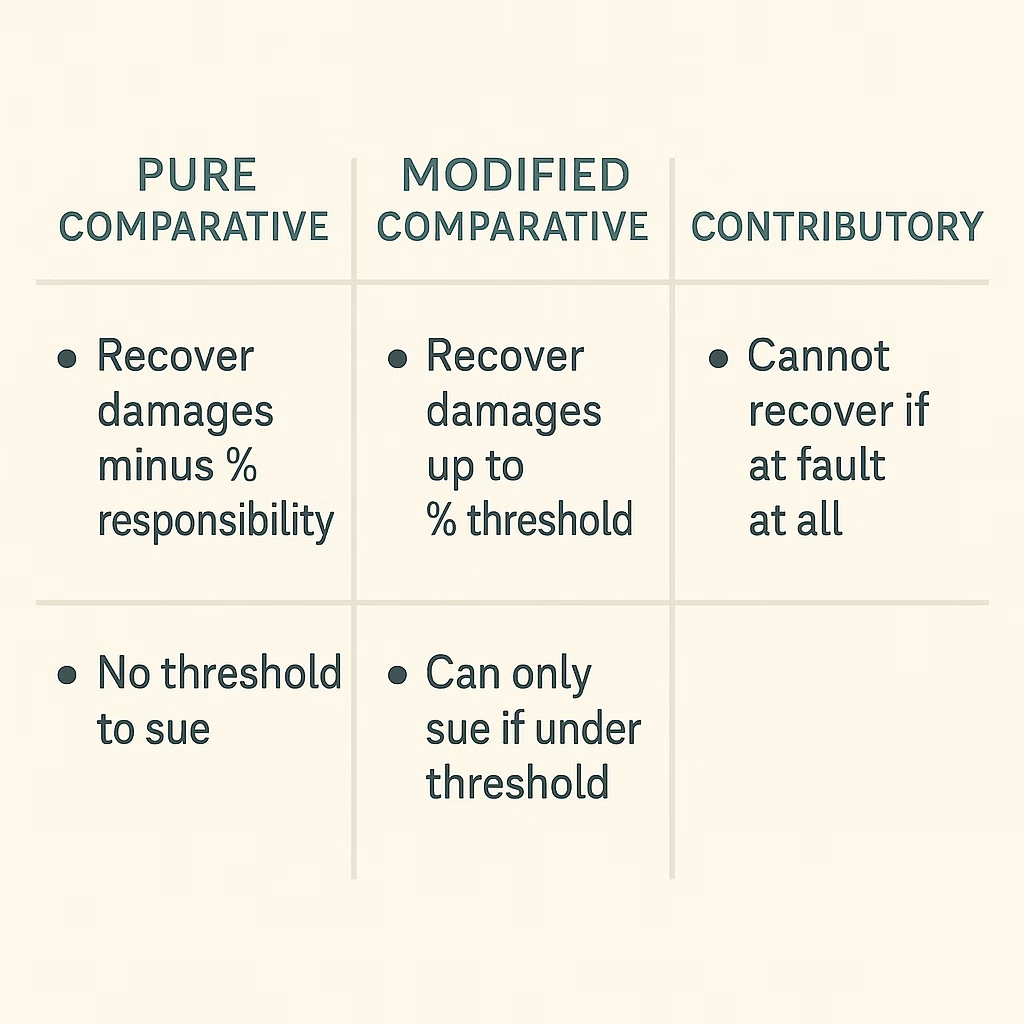
In a pure comparative negligence system, your compensation is reduced by your percentage of fault, but you are not barred from recovering unless you’re 100% responsible.
That means:
10% at fault → you can recover 90% of your damages
60% at fault → you can still recover 40%
90% at fault → you can still recover 10%
Some states, including California, Florida, and New York, follow a version of pure comparative negligence.
Example:
You suffer $80,000 in damages (medical bills, lost wages, etc.).
A jury decides you were 70% at fault and the other driver 30% at fault.
In a pure comparative state, your potential recovery might be 30% of $80,000 = $24,000, assuming no other limits apply.
Even though you bear most of the blame, the law still recognizes the other driver’s share of responsibility and allows you to recover that slice of your damages.
Most comparative-negligence states use a modified version. In these systems, you can recover damages only if your fault is below a certain threshold, usually 50% or 51%.
There are two common flavors:
50% bar rule – You can recover only if your fault is less than or not more than 50%, depending on state wording. If your fault reaches or exceeds 50%, you may be barred.
51% bar rule – You can recover as long as your fault is 50% or less. Once you’re 51% or more at fault, your claim may be barred.
Some states spell this out very clearly. For example, Illinois’ law says that an injury victim may generally recover damages if they are 50% or less at fault, but not if they are more than 50% at fault, and their recovery is reduced by their share of fault.
Example with a 51% bar:
You have $100,000 in damages.
Scenario A: You’re found 40% at fault → You could recover 60%, or $60,000.
Scenario B: You’re found 51% at fault → You may recover nothing.
In modified systems, a small change in the fault percentage (say, from 49% to 51%) can be the difference between some compensation and no compensation at all.
In the few states that still follow pure contributory negligence, the rule is stark:
If you are negligent to any degree and that negligence contributed to the accident, you may be barred from recovering from the other party.
It does not matter whether your share of fault was:
1%
10%
20%
Under contributory negligence, any fault can be enough to defeat your claim entirely.
Because of that, contributory states are especially high-risk environments for injured people who try to handle claims on their own. The other side only needs to persuade the fact-finder that you made any mistake that legally counts as negligence, and your compensation could be wiped out.
In these states, getting help quickly—before you say or sign something that could be twisted against you—can be critical.
Let’s turn the theory into real numbers.
The basic idea in comparative negligence is:
Your compensation = Total damages × (100% − your fault percentage)
(Subject to other limits like policy limits and no-fault rules.)
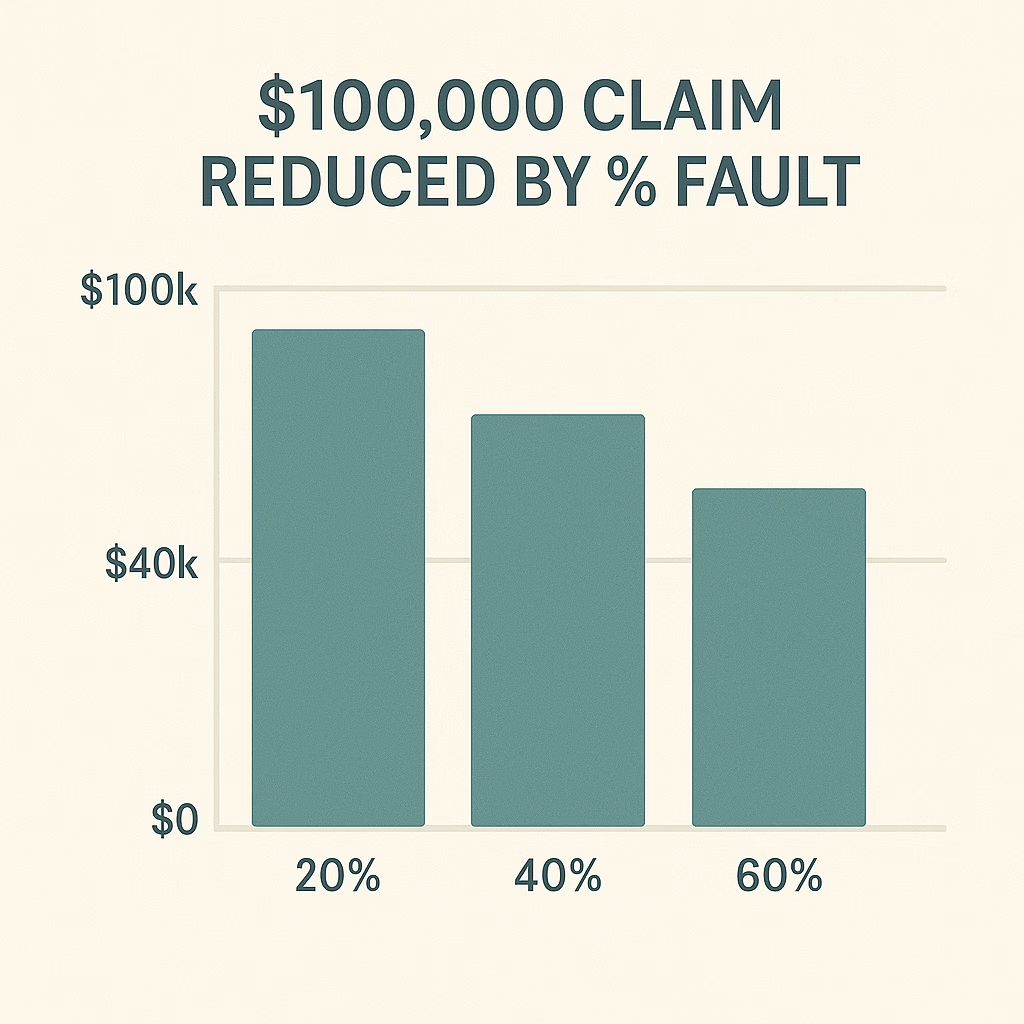
Example 1 – 20% at fault in a pure comparative state
Total damages: $100,000
Your fault: 20%
Other driver’s fault: 80%
Potential recovery: 80% of $100,000 = $80,000
Example 2 – 40% at fault in a pure comparative state
Same $100,000 in damages
Your fault: 40%
Potential recovery: 60% of $100,000 = $60,000
Example 3 – 60% at fault in a pure comparative state
Your fault: 60%
Potential recovery: 40% of $100,000 = $40,000
Under pure comparative negligence, the math is straightforward—you always get the remaining percentage as long as someone else is at least partly at fault.
In modified comparative states, the math only happens if you’re below the bar:
Example 4 – 40% at fault in a 51% bar state
Damages: $100,000
Your fault: 40% (below 51%)
You can recover 60% → $60,000
Example 5 – 51% at fault in a 51% bar state
Damages: $100,000
Your fault: 51% (over the bar)
You may be barred from recovery altogether.
These rules can interact with other parts of your car accident claim, such as:
Policy limits (the at-fault driver’s insurance may not cover the full amount).
No-fault / PIP laws, in states where your own insurance pays certain benefits regardless of fault.
Joint and several liability rules if multiple defendants are involved.
| Damages | System Type | Your Fault | Can You Recover? | Approx. Payout (before limits) |
|---|---|---|---|---|
| $100K | Pure comparative | 40% | Yes | $60K |
| $100K | 51% modified comparative | 40% | Yes | $60K |
| $100K | 41% modified comparative | 51% | No | $0 |
| $100K | Contributory | 1% | Likely no | $0 |

Comparative negligence isn’t just a courtroom concept. Insurance companies use it every day when they evaluate and settle claims.
The Illinois Department of Insurance, for example, explains that comparative negligence laws determine how responsibility is shared and who receives how much when more than one person contributed to an accident.
In practice, that means an adjuster may:
Review the police report,
Look at statements from drivers and witnesses,
Check photos or video,
Consider the traffic laws and who violated what.
Then they’ll assign fault percentages—say, 70% for the other driver, 30% for you—and use that to discount your claim.
Common blame-shifting tactics include:
Saying you were speeding or “going too fast for conditions.”
Arguing you were following too closely in a rear-end crash.
Alleging that you were distracted (for example, by a phone).
Raising a seatbelt defense (though whether and how seatbelt non-use affects compensation depends heavily on state law). [Unverified]
Adjusters may present these percentages as if they’re objective facts, but they’re often negotiating positions. In some states, regulators even warn insurers not to apply comparative negligence without reasonable evidence of how much each person contributed.
Bottom line: The insurer’s fault percentage is not automatically correct and may be open to challenge.
Every crash is unique, but certain patterns show up again and again. The examples below are illustrative, not predictions of what will happen in any particular state or case.
Driver A is stopped at a red light.
Driver B is following behind but is looking down at the radio and hits Driver A from the rear.
Investigation shows Driver A had been braking suddenly and was also speeding just before the intersection.
In many places, rear-end collisions create a presumption that the rear driver was negligent for following too closely or not paying attention. But if evidence shows that Driver A’s behavior also contributed, a fact-finder might split fault, for example:
Driver B: 80%
Driver A: 20%
If Driver A’s damages are $50,000 and the state follows comparative negligence, Driver A might recover 80% of that, or $40,000, in a pure or below-bar modified system.
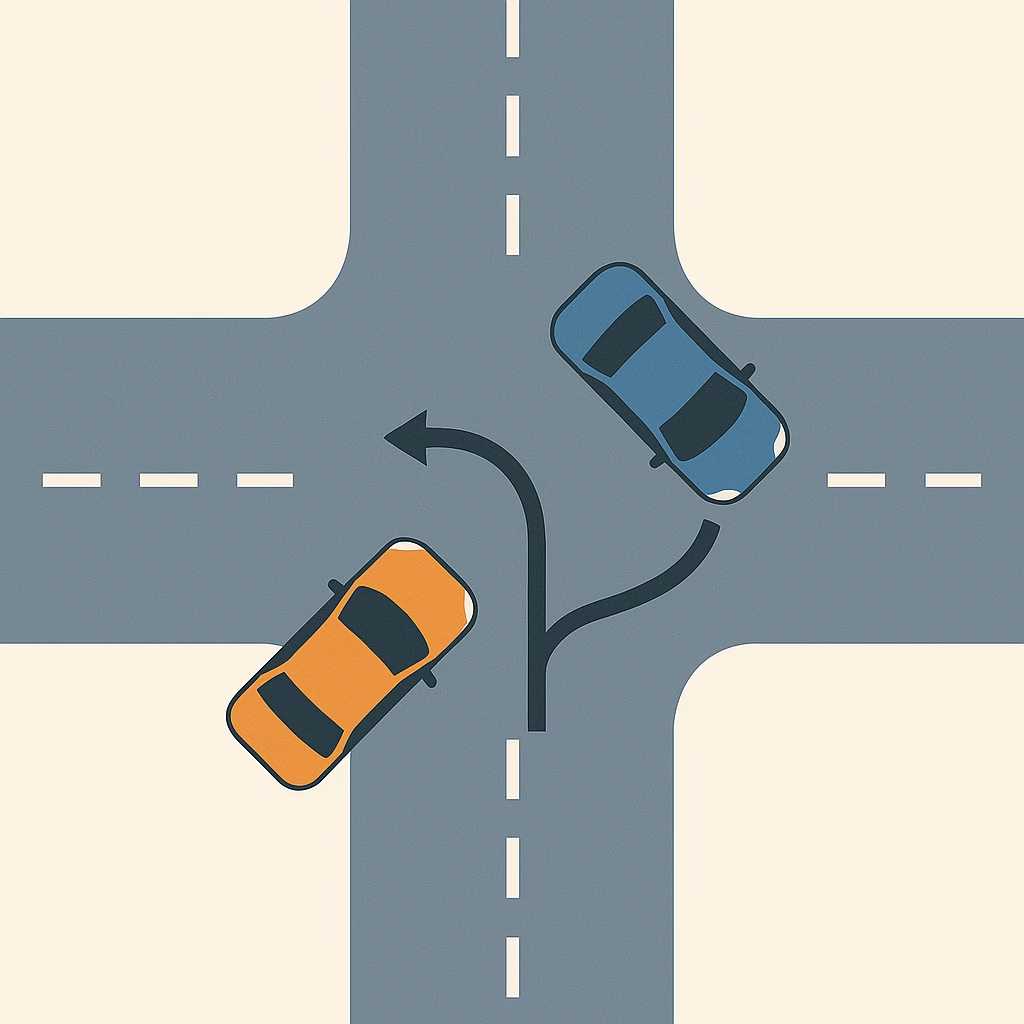
Driver A is turning left on a green light (no arrow).
Driver B is coming straight through the intersection; the light is also green.
Driver B is speeding and possibly glances at a text message.
Typically, left-turning drivers must yield to oncoming traffic, so Driver A may take a large share of the fault. But Driver B’s excessive speed and distraction may also matter.
A possible (illustrative) split:
Driver A: 60%
Driver B: 40%
If Driver B suffers $100,000 in damages:
In a pure comparative state: Driver B could recover 40%, or $40,000.
In a 51% bar state: Driver B is under 51% fault, so they might still recover that 40%.
In a 50% bar state: If the rule bars recovery at 50% or more and the fact-finder decided Driver B was exactly 50% at fault instead, the result could flip from “some recovery” to “no recovery.”
Driver A brakes suddenly for traffic.
Driver B follows too closely and rear-ends A.
Driver C is texting and slams into B, pushing B further into A.
The final damage might be spread across all three vehicles. Fault could look something like:
Driver A: 10% (for abrupt or unsafe braking)
Driver B: 40% (following too closely)
Driver C: 50% (distracted driving)
Each driver’s claim then gets adjusted by their percentage of fault, and comparative negligence becomes central to who recovers how much.
Comparative negligence is not a single national rule; it’s a patchwork of state laws.
Resources like Justia’s 50-state survey of comparative and contributory negligence laws show that states generally fall into:
A small group of pure comparative negligence states,
A large group of modified comparative negligence states (with 50% or 51% bars), and
A small handful of contributory negligence states.
Some states, like Illinois, also spell out their comparative negligence rules in statutes and in consumer-facing materials. Illinois explains, for instance, that you can usually collect damages if you are 50% or less at fault, and that your settlement is reduced by your percentage of fault.
Because of these differences:
The same crash facts can lead to very different outcomes depending on the state.
In one state, you might recover a portion of your damages despite high fault;
In another, even a small amount of fault might destroy your claim.
It’s often wise to:
Check a reputable chart or survey describing your state’s negligence system.
Talk with a professional who handles car accident cases in your state and knows how local courts apply comparative negligence in practice.
If 833-GET-PAID works across multiple states, they may also help you understand which negligence system applies to your specific crash.
Even if you think you might share some blame—or the adjuster says you do—you’re not powerless. There are practical steps you can take to protect your claim and challenge unfair percentages of fault.

If it’s safe, capture wider-angle shots showing lane markings and sightlines.
Collect names and contact information for witnesses who saw what happened.
Detailed evidence can make it harder for an insurer to casually assign you an inflated percentage of fault.
Even if you feel “mostly fine,” it’s important to:
Get checked soon after the crash.
Report all symptoms, even ones that seem minor at the time.
Follow through with recommended treatment.
This helps create a clear medical record linking your injuries to the collision, which is essential when calculating total damages—especially before any comparative negligence reduction is applied.
If the adjuster tells you, “We’ve decided you’re 40% at fault,” ask for more than just the number. Specifically:
Request a written explanation of how they calculated your percentage of fault.
Ask what evidence they relied on (e.g., police reports, witness statements, photos).
Clarify which traffic laws or safety rules they believe you violated.
Some regulators, such as in Pennsylvania, caution insurers that they shouldn’t use comparative negligence to reduce payments without reasonable evidence of your negligence and its relationship to the total negligence involved.
If the insurer’s number seems unfairly high, consider:
Looking for dashcam footage (yours or another driver’s).
Asking nearby businesses if they have security camera footage of the intersection or roadway. [Unverified]
Getting supplemental statements from witnesses the adjuster may have overlooked.
Reviewing the police report for errors or incomplete information.
Any evidence that shows the other driver was more careless—or that you were less careless—can support a lower percentage of fault.
If:
Your injuries are serious,
The insurer claims you’re near or over the 50% or 51% bar, or
There are multiple vehicles and conflicting stories,
then it may be risky to handle everything alone. A professional advocate can:
Analyze the crash details and state law,
Challenge the insurer’s fault allocation, and
Present a stronger case for a lower fault percentage on your side. [Unverified]
You can reach out to 833-GET-PAID to discuss how comparative negligence might impact your claim and what options you have to push back against an unfair settlement.
There’s no rule that says you must hire help after a crash. But comparative negligence can make some cases much more complex, especially when:
You have significant injuries or long-term medical issues.
The insurer is insisting that you are 50%+ at fault in a modified comparative state.
The crash happened in a contributory negligence state, where any fault could bar recovery.
There are three or more vehicles, or issues like road defects or defective car parts.
In these situations, a professional can:
Review police reports, witness statements, and photos,
Spot legal defenses or traffic-law violations that show the other party bears more fault,
Work with investigators or experts to reconstruct the crash, [Unverified]
Negotiate with the insurer using a clear, evidence-backed allocation of comparative fault.
A service like 833-GET-PAID can be a first point of contact to understand your options, how your state’s negligence rules apply, and whether you may benefit from legal representation. [Unverified]
Comparative negligence can feel like a dry legal concept, but in a car accident case, it’s real money:
The same $100,000 injury could end in $80,000, $40,000, or even $0 depending on your assigned percentage of fault and your state’s negligence rules.
Understanding how the system works helps you:
Recognize when an insurer is using comparative negligence to lowball you,
See why your state’s system type (pure / modified / contributory) matters,
Take practical steps to document your case and push your fault percentage down,
Decide when it’s time to bring in a professional to protect your rights.
Use this article alongside your Car Accident Insurance and Compensation Guide to get a fuller picture of your claim. And if an insurance company is blaming you for more of the crash than seems fair, consider contacting 833-GET-PAID to talk through your options and how to pursue the compensation you may be entitled to.
In many comparative negligence states, yes. Your compensation is usually reduced by your percentage of fault instead of being denied entirely.
In pure systems, you can recover even if you were mostly at fault, but your award is reduced in proportion to your negligence. In modified systems, you’re cut off if your fault reaches a 50% or 51% threshold, depending on the state.
In contributory negligence states, if you’re found even slightly at fault for the accident, you may be barred from recovering any damages from the other party.
Adjusters review police reports, statements, photos, and traffic laws to estimate each driver’s role in the crash, then apply comparative negligence to split responsibility and adjust payouts.
Not automatically. Especially in modified or contributory states, even a small change in your assigned fault percentage can drastically change what you can recover, so it may be wise to get a professional review before accepting.